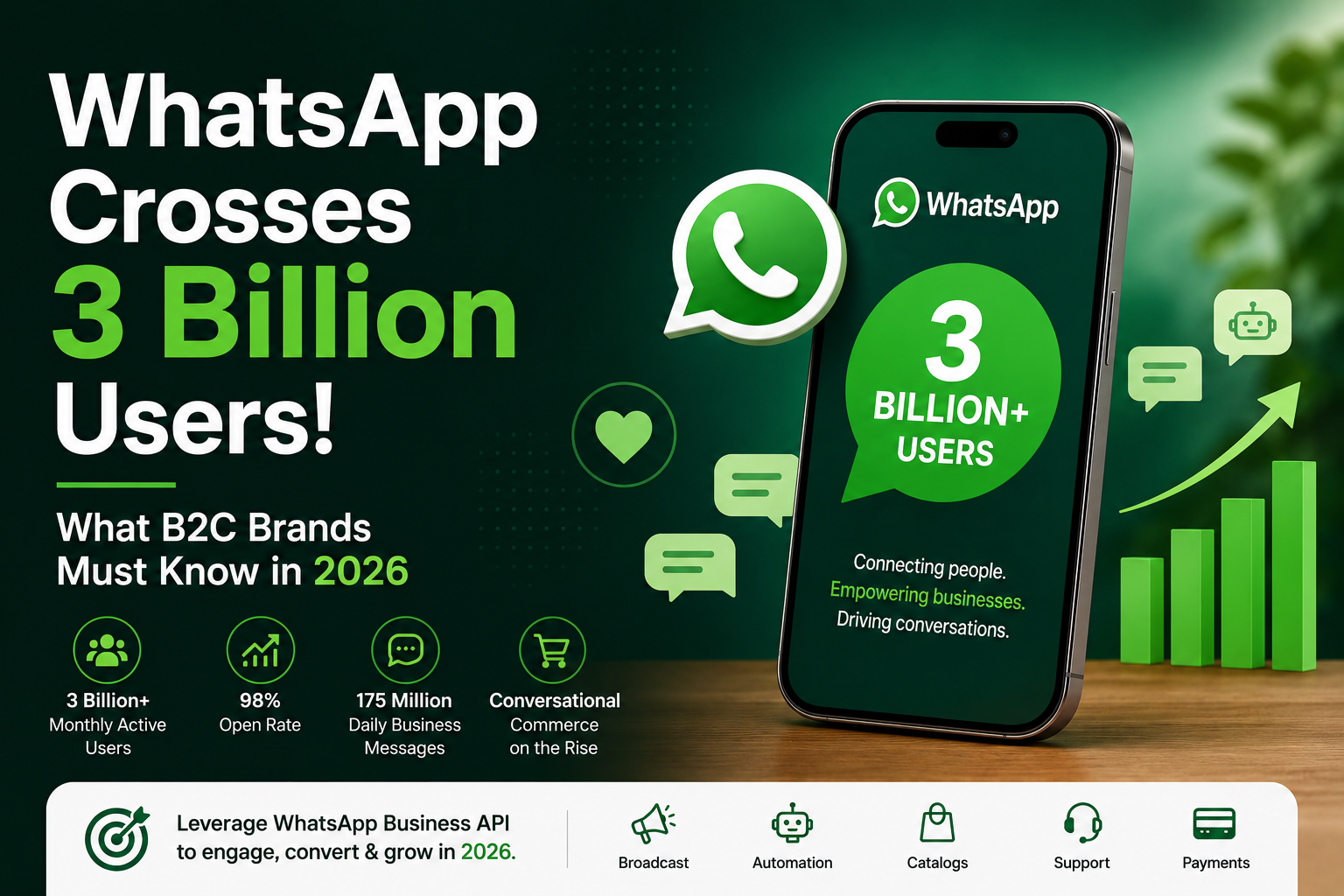
Three billion people now use WhatsApp every month. Meta confirmed this in September 2025, making it the first messaging platform in history to cross that mark. That is more than a third of the entire world population on a single app, every single month.
For B2C brands, this is not just a headline worth bookmarking. It is a shift in where customers actually live. Those 3 billion users are not passively scrolling. They are messaging businesses, browsing product catalogues, expecting replies within minutes and completing purchases without ever leaving the chat. 175 million of them message a business account every day.[2]
If your brand does not have a WhatsApp strategy today, you are not behind on a trend. You are absent from where your customers already are.
The MilestoneHow WhatsApp Reached 3 Billion and Why This Time Is Different
WhatsApp launched in 2009 and was acquired by Facebook, now Meta, in 2014 for $19 billion. It grew steadily through the 2010s, reaching 800 million users by 2015 and crossing 1.5 billion by 2018. The jump from 2 billion to 3 billion happened faster than any previous interval, driven by mobile internet expansion across South Asia, Latin America and sub-Saharan Africa.[3]
What is different now is not the user count. It is how the platform is being used. In 2018, WhatsApp was a personal messaging app. By 2023, businesses were starting to show up. In 2025, it has become a full commercial layer, with product catalogues, payment rails, AI-powered chatbots, broadcast channels and CRM integrations all operating natively inside the app. It is no longer a messaging tool that businesses can optionally use. It is the infrastructure through which hundreds of millions of customers expect to interact with brands.
WhatsApp is the number one messaging app in over 100 countries and processes more than 150 billion messages every single day. That works out to roughly 19 messages per person on the planet, every day.
Source: DataReportal Digital 2025 Global Overview and Meta Q1 2025 Earnings Report
The Engagement DataWhatsApp Monthly Active Users (2015 to 2025)The Numbers That Should Change Your Channel Strategy
Email marketing has an average open rate of 20 to 21 percent. You craft the subject line, A/B test the send time, optimise the preview text, and still four out of five recipients never open it. This is the accepted reality for most marketing teams.
WhatsApp operates on entirely different numbers.
Message Open Rates by ChannelOpen rate tells only part of the story. WhatsApp promotional messages achieve click-through rates between 45 and 60 percent, compared to 2 to 5 percent for email.[4] Messages are read within five minutes of delivery 88 percent of the time.[5] The average user checks WhatsApp 23 to 25 times a day and spends about 38 minutes on the app.[5] For a brand, that is 23 organic moments of potential attention, on a channel your customer is already monitoring throughout their day.
Geography88%Messages read within 5 minutes45-60%Click-through rate on promotions23xDaily app checks per user38 minDaily time spent on WhatsAppWhere the 3 Billion Are and Why Location Matters
WhatsApp’s user base is not evenly distributed, and that concentration tells a brand exactly where to focus.
Top WhatsApp Markets by Monthly Active Users (2025)India leads by a significant margin with over 535 million active users. Three out of four Indian smartphone users are on WhatsApp.[5] The country also accounts for the largest concentration of WhatsApp Business users globally, with 15 million business accounts already operational.[2] For any brand operating in India, WhatsApp is not a secondary channel. It is the default expectation.
Brazil is the second largest market, where 91 percent of internet users are active on WhatsApp.[3] Indonesia, Mexico and Germany follow closely, each with penetration rates above 65 percent among internet users. In these markets, brands that are absent from WhatsApp are simply unreachable for a large portion of their potential customers.
Business ImpactWhat the 3 Billion Milestone Means for B2C Brands
The milestone changes the competitive calculus for B2C businesses in five concrete ways.
💬Conversation replaces broadcastWhatsApp enables genuine two-way dialogue at scale. 64 percent of users say it gives them a stronger personal connection with the brands they message than any other channel.64%🛒Commerce happens in the chatMore than 40 million users browse business catalogues inside WhatsApp every month. 65 percent of shoppers say they are more likely to buy from a business they can message directly.65%🤖Automation handles most queriesWell-built WhatsApp chatbots resolve 60 to 80 percent of incoming queries without human intervention, reducing support costs by around 30 percent.30% savings📣Channels scale broadcast reachWhatsApp Channels reached 500 million monthly active users within 12 months of launch, the fastest any broadcast feature on a messaging app has ever grown.500M MAUOne figure stands out beyond the others: 53 percent of retailers now automate messaging on the WhatsApp Business Platform.[2] Automation is no longer a future capability to plan for. It is already the baseline among B2C competitors.
Channel ComparisonWhatsApp vs Email vs SMS: The Honest Numbers
Before shifting budget, it helps to see the complete picture. WhatsApp does not make email redundant, but on every meaningful engagement metric it performs substantially better.
Metric SMS Open Rate 95 to 98% Best 20 to 21% 82% Click-Through Rate 45 to 60% Best 2 to 5% 6 to 8% Average Response Time Under 90 seconds Best 6 to 12 hours About 3 minutes Rich Media Full support (video, PDF, buttons) Partial None In-chat Purchases Yes, via Catalogue and Pay No No Personalisation Deep, via CRM integration Deep Limited Spam Perception Low, opt-in only High Medium The opt-in requirement on WhatsApp deserves emphasis. Brands can only message users who have explicitly consented to hear from them. This is actually an advantage, not a constraint. Audiences are genuinely interested, so engagement quality remains high and unsubscribe rates stay low. Building your WhatsApp subscriber list should begin immediately through checkout opt-ins, website widgets and post-purchase flows. Get started through the official WhatsApp Business Platform or the Meta developer documentation.
Brand ResultsReal Brands. Real Results.
The engagement numbers hold up when you look at specific brand outcomes.
🧴Unilever138% increase in salesUnilever’s WhatsApp chatbot campaign in Brazil generated a 138 percent uplift in product sales, outperforming every traditional digital channel running in the same period. The bot offered personalised product recommendations based on customer responses in real time.💙Nivea207% of planned reach achievedNivea’s WhatsApp marketing campaign exceeded its reach target by more than double, generating far higher engagement than comparable social media campaigns in the same markets and time period.🏦Banking and Healthcare Sector$11 billion in projected savings by 2026WhatsApp automation across banking, insurance and healthcare is projected to unlock $11 billion in annual cost savings, driven by chatbot handling of claims queries, appointment scheduling and policy renewals, reducing human agent workload by more than 30 percent.Action Plan🛍️D2C E-commerce3x higher conversion than emailAcross D2C brands, WhatsApp abandoned cart messages achieve three times the conversion rate of email equivalents, with open rates above 60 percent and average customer response times under two minutes.Five Things B2C Brands Should Do on WhatsApp in 2025
Large enterprises are moving fast. 80 percent plan to adopt the WhatsApp Business API by the end of 2025,[4] and API message volume is projected to grow by 1,590 percent between 2020 and 2027.[5] The window to move first is open, but it is shrinking.
1Get your business verified
The green verified badge on WhatsApp builds immediate trust at a time when users are increasingly cautious about messaging scams. Apply through Meta Business Suite with a registered business number, verified domain and clear brand identity. Verified accounts grew 28 percent year on year in 2025.
2Start building your opt-in subscriber list now
WhatsApp’s reach is gated behind consent. You can only contact users who have explicitly opted in. Add opt-in widgets to your checkout flow, website header, post-purchase emails and social bios. Every week without a list-building mechanism is measurable audience growth left behind.
3Deploy a chatbot for first-response support
75 percent of consumers expect a response within five minutes of reaching out to a brand online. A well-configured chatbot can handle 60 to 80 percent of Tier-1 queries, including order status, FAQs and returns, in under 30 seconds, freeing your human agents for genuinely complex issues.
4Use broadcast lists for retention, not just acquisition
WhatsApp broadcast messages sent to opted-in audiences achieve click-through rates of 40 to 60 percent. This makes them far more effective for loyalty campaigns, exclusive offers and re-engagement sequences than email or SMS at a fraction of the cost per interaction.
5Connect WhatsApp to your CRM
The WhatsApp Business API integrates with major CRM platforms including Salesforce, HubSpot and Zoho. This unlocks segment-specific campaigns, purchase-triggered message flows and proper attribution tracking, turning WhatsApp from a support channel into a measurable revenue channel.
What Is NextQuick wins you can start this week
- Create or upgrade to a WhatsApp Business account, either the free app or via API
- Complete your business profile including logo, description, website link and business hours
- Add a Chat on WhatsApp button to your website header and contact page
- Set up an automated greeting, away message and quick replies for your top five FAQs
- Run a WhatsApp opt-in prompt on your checkout page for two weeks and measure the sign-up rate
- Send one broadcast message to existing contacts and compare the open and click rates against your last email campaign
The Road to 3.5 Billion
WhatsApp is projected to reach 3.5 billion monthly active users by the end of 2026.[3] More significant than the user count is what Meta is building into the platform for commercial use.
WhatsApp Pay is expanding beyond its current live markets of India and Brazil. This enables customers to browse a brand’s product catalogue inside a WhatsApp conversation and complete the purchase without ever leaving the app. The friction between discovery and transaction is being removed entirely.[6]
AI agents inside WhatsApp are moving from experimental to mainstream. Meta is integrating Meta AI natively into the platform, giving brands access to AI-powered shopping assistants and support bots. McKinsey’s research projects automation of this kind reduces customer service costs by 30 percent at scale.[7]
WhatsApp Channels completed their first year with 500 million monthly active users, the fastest a broadcast feature has grown on any messaging platform.[1] For brands, Channels offer a zero-friction way to publish content and build audiences at scale, sitting alongside the more personal two-way conversations of Business accounts.
The brands that will lead the next decade of B2C are not those with the biggest advertising budgets. They are the ones building real, scalable relationships with customers. WhatsApp is where those relationships are happening now.
Times Mobile Editorial Team
Sources and References
- [1] Meta Platforms, Official Investor Relations and SEC Filings (2025)
Confirms the 3B MAU milestone and WhatsApp Channels growth data.
https://investors.fb.com/financials/sec-filings/default.aspx- [2] Meta for Business, WhatsApp Business Platform
Business account totals, 175M daily messages, API capabilities and catalogue features.
https://business.whatsapp.com/- [3] Statista, Monthly Active WhatsApp Users Worldwide
Historical MAU data from 2013 to 2025, including country-level breakdown.
https://www.statista.com/statistics/260819/number-of-monthly-active-whatsapp-users/- [4] Statista, WhatsApp Topic Overview and Business Data
Open rate benchmarks, enterprise API adoption and growth projections.
https://www.statista.com/topics/2018/whatsapp/- [5] DataReportal, Digital 2025 Global Overview Report
Daily usage, time on app, per-country penetration and engagement depth.
https://datareportal.com/reports/digital-2025-global-overview-report- [6] Meta, WhatsApp Payments Official Product Page
Rollout details for India and Brazil and planned expansion markets.
https://business.whatsapp.com/products/payments- [7] McKinsey Digital, Customer Service Automation Insights
Cost reduction benchmarks from AI automation, including the 30 percent savings projection.
https://www.mckinsey.com/capabilities/mckinsey-digital/our-insights- [8] Campaign Monitor, Email Marketing Benchmarks 2024
Industry baseline for email open rates (20 to 21 percent) and click-through rates.
https://www.campaignmonitor.com/resources/guides/email-marketing-benchmarks/- [9] Meta Developer Documentation, WhatsApp Business API
Technical reference for API capabilities, opt-in rules and message templates.
https://developers.facebook.com/docs/whatsapp/- [10] Meta for Business, WhatsApp Business Platform Product Overview
Catalogue, broadcast, automation and CRM integration features.
https://business.whatsapp.com/products/business-platform
Last Modified: June 19, 2026